The Manufacture of Adolescence
Companion piece. Its predecessor, Shadow Politics, is the demand side, explaining why the captured mind wants the cage and defends it as moral clarity. This is the supply side, explaining who builds the cage, and why it takes no conspiracy. If you're inclined to dismiss this one as paranoid structuralism, the other answers with the mechanism in your own head; if you dismissed that one as just-so psychology, this one answers with the revenue statements. Together they don't leave a clean way out, which is the point.
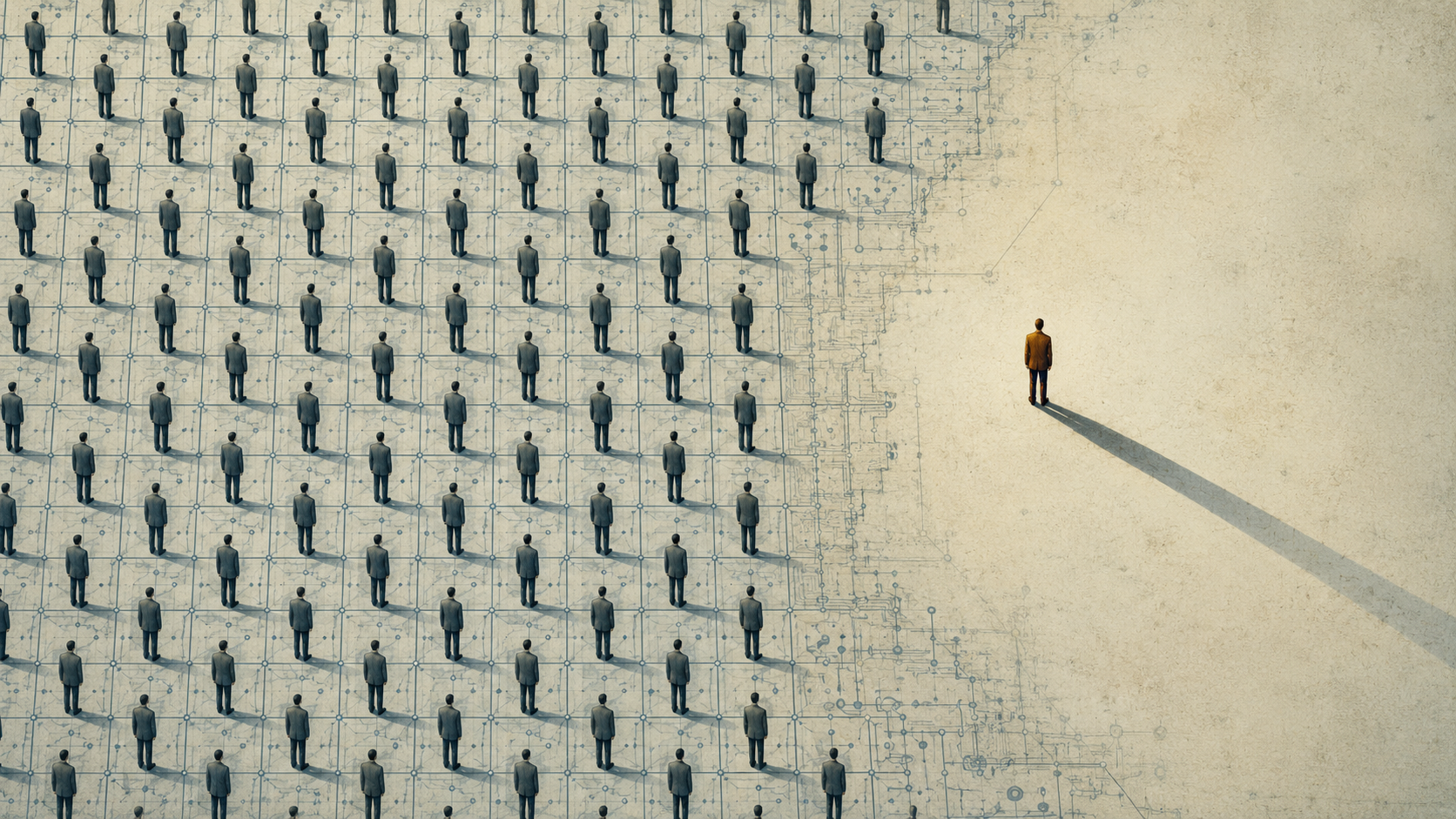
Someone has to want you this way. Here is who — and why it isn't a conspiracy.
You are some age, some sex, some nationality, some income bracket. None of that is an identity. It is a set of facts that happen to be true of you, inert as your blood type. The work of converting those facts into a self — into a we with a border and an enemy waiting on the far side of it — is not something you do. It is done to you, continuously, by people who are extremely good at it and who need you to remain exactly this convertible.
That conversion is the whole game. A category is a classification that is simply true of you whether you affiliate or not. A group is a felt allegiance that supplies a self and draws a line. The distance between the two is short, and an entire ecosystem lives inside it. "You happen to be X" is a fact. "You are an X, and they are coming for you" is a product. The assembly line that turns the first sentence into the second is the most consequential machinery in modern political life, and almost nobody looks at it directly, because while it is running it does not feel like machinery. It feels like waking up and noticing who your people are.
Let me be precise about the accusation, because the strong version and the cheap version sound alike. The cheap version is that someone is doing this on purpose — a room, a memo, a plan. I cannot prove that and do not need it. The strong version is worse, because it requires no villain and survives the absence of one: the incentives converged. Nobody decided. Everybody, independently, optimizing for their own survival, selected for the same thing, and the same thing turned out to be your arrested development.
Begin with the least romantic part. In Seeing Like a State, James C. Scott describes the property that makes a population governable: legibility. A state cannot administer what it cannot read, so it imposes a grid that flattens messy, local, idiosyncratic reality into standardized categories a bureaucracy can process. A self that has been sorted is legible. A self that has not is noise. Now notice that the same logic governs anyone who needs populations to behave -- a campaign, a network, a platform, an advocacy shop. A grouped person can be polled, targeted, mobilized, sold to, and turned out on schedule. A self-authored person with internal standards that don't move with the tribal weather can be none of these things. The grouped input is cheap. The autonomous input is ruinously expensive. Every actor in the system faces that price difference, and every actor responds to it the same way, and you do not need a single one of them to intend the aggregate result for the aggregate result to be a citizenry held at the developmental stage where the group does the thinking.
The clearest place to watch the machinery run is the media, and this is the part that needs no conspiracy at all, because it is printed on every revenue statement. There was a broadcast era that, for all its faults, paid the news media to address a public -- a heterogeneous audience that had to be held together, which forced at least a gesture toward common ground. The model that replaced it pays them to address a tribe: a narrow, pre-sorted segment whose loyalty is monetized in direct proportion to how threatened and righteous you can keep it. The fragmentation everyone laments is not a betrayal of the business model. It is the business model. You did not lose balanced news to malice. You lost it to a P&L statement, which is harder to argue with and far harder to forgive.
Here I hand off, because the inside of the captured mind is the subject of another essay and I do not want to re-explain what it explains better. Henri Tajfel showed in the 1970s that the boundary-drawing machinery activates on nothing — a coin flip, a preference between two painters — and that once a person says we and they, the far side of the line begins filling with disowned darkness. That is the demand side: why the prisoner wants the cell and defends it as moral clarity. My subject is upstream of that. I am not asking why the captured person fills the border with monsters. I am asking who has every reason to keep drawing the border and keeping the monsters vivid — and why they will fund anything except your release.
Because that is the cost the system is actually extracting. Becoming a person in the full sense is slow, uncomfortable work: sitting with being undefined, carrying responsibility no group will absorb, thinking against your own side and surviving the loss of approval that follows. Frank Furedi calls what institutions offer instead infantilization — a ready-made identity collected at the door in exchange for belonging, a shortcut around exactly the labor that would have made you ungovernable. The trade is attractive and the cost is hidden, and the cost is the apparatus of self-authorship itself. What you get is permanent adolescence at scale: a population maximally responsive to peer pull, maximally pained by departure, held at the threshold of adulthood and never permitted across, because the far side of that threshold is where the steerability ends.
At which point the smartest objection in the room stands up, and it deserves an answer instead of a sneer. If people are this manipulable, isn't managed manipulation better than the unmanaged kind? Better a credentialed institution with stated goals and peer review than a rogue entrepreneur. Capture them for their own good, before someone worse does. This is Walter Lippmann's argument, made in 1922, and Lippmann was not a cynic — he was being coldly consistent. A public navigating by the pictures in its head, he reasoned, cannot govern itself, so a class of experts must process reality on its behalf.
The argument has three cracks, and they go all the way through.
The first is mechanical: you cannot use capture to manufacture autonomy. The tool does not perform that operation. Keeping a population inside the tribal loop does not guide its development toward self-authorship; it arrests it, because the arrested state is the one the manager requires. Protection that depends on the protected staying dependent is not protection. It is the maintenance of your own necessity, wearing the costume of care.
The second is epistemic: the engineers are not standing outside the machine. They are nodes in it, running their own identity software, optimizing for outcomes legible to their own credentialed in-group. The twentieth century's record of large-scale social engineering is mostly a record of that confidence producing results nobody intended and nobody would later sign.
The third is that the logic proves too much. If we don't sort them, someone worse will. If we don't run the propaganda, someone worse will. If we don't addict them to our platform, someone worse will. Pushed to its limit, this is indistinguishable from the thing it claims to prevent, and it is the oldest self-justification in the history of power. Every institution that ever decided it knew better than the people inside it told exactly this story about itself.
Now the part where I refuse to let myself off the hook, because the thesis has a real weakness and pretending otherwise would be its own kind of capture. An argument that reads group-promotion as the cage and individualism-promotion as "just another managed identity" can absorb any evidence, and a claim that explains everything explains nothing. So here is the dare, stated plainly enough to be used against me: if institutions and media measurably rewarded positions that cut against their own audience's tribe; if the business model paid for de-escalation; if the funded programs aimed at producing citizens who could leave the fold without penalty — the thesis is dead, and I will bury it. It survives only because those things mostly do not pay and the things that do pay run the other way. That is an empirical claim. Go check it. The reason I am comfortable handing you the test is that I have read the same revenue statements you can.
The same standard forces honesty about the wilder claim — that street takeovers, flash-mob looting, and the pull of gang life precipitate out of this same machine. I won't assert it, because each has dense local causes and a theory that explains all disorder with one variable has overreached into the very legibility it condemns. But I will put the question where the dismissal has to do some work: those kids are visibly chasing belonging, significance, and the adrenaline of a collective that overrides individual conscience — which is close to what radicalization researchers like Arie Kruglanski call the quest for personal significance. If the managed, sanitized groups on offer are not supplying it, something will. So tell me what is. "Correlation isn't causation" is true and also not an answer.
The reply to Lippmann was given in his own decade by John Dewey, and it is still the reply, but it needs a correction I owe to anyone who has actually lived the thing. Dewey said the public is not a fixed quantity of incompetence to be managed around but a capacity that can be cultivated. He was right about the materials of thought — you reason in an inherited language, with concepts you did not invent, and in that narrow sense nobody is self-made. But he was reaching for "cultivate," and cultivation quietly smuggles the cultivator back in. The harder truth is that the disposition toward autonomy — the early, stubborn comfort with one's own unendorsed thoughts, the low pull toward the group's approval — is substantially native. It shows up against the grain of the managed environment, in people no one taught it to. And that is precisely why it is the one thing the machine can neither manufacture nor reliably suppress. It is not produced. It leaks.
This is the worst news the system could receive, and the best news in this essay. The exit cannot be administered, scaled, scheduled, or organized into a movement, because it was never a program. It arrives unevenly, through temperament, crisis, solitude, some encounter that cracks the narrative, and it is recognizable by its uselessness to everyone who profits from the loop. The self-authored individual requires persuasion instead of activation. They will not perform loyalty on cue. They are, in the language of systems, a high-variance node: unpredictable from their demographics, invisible to the turnout model, and not grateful in any institutionally legible way. They are the line item that cannot be optimized, which is to say the one thing the optimization was built to prevent.
So no, this does not end with a plan, because a plan is the genre of the thing being diagnosed. It ends with the only move that costs the machine something and asks nothing of anyone but you: a self that stays coherent without an enemy to define it against. That self is the single product the system cannot manufacture, route around, or sell back to you at a markup. Building one is slow, mostly invisible, and comes with no banner to march under. It does not announce itself, and it does not require their permission. Which is fortunate, because it was never going to be granted.